Lot No. LOT-6403 · offered September 29, 2026
Precision Agriculture & AgTechLot sheet
Precision Agriculture's Green Claims Lack Evidence, Researchers Say
A Nature-portfolio review finds precision agriculture's environmental claims untested, as the House Farm Bill draft would cover up to 90 percent of growers' costs for qualifying practices.
Market notes
- A January peer-reviewed study in the Nature portfolio found claims that precision agriculture reduces fertilizer, pesticide, water use and greenhouse gas emissions are 'not fully tested nor supported by evidence.'
- USDA and NSF spent $200 million on precision agriculture R&D between 2017 and 2021; USDA spent another $290 million on automation projects from 2008 to 2018, per GAO.
- The House Agriculture Committee's Farm Bill draft would let precision agriculture qualify for conservation programs with up to 90 percent federal cost-share through EQIP and CRP.
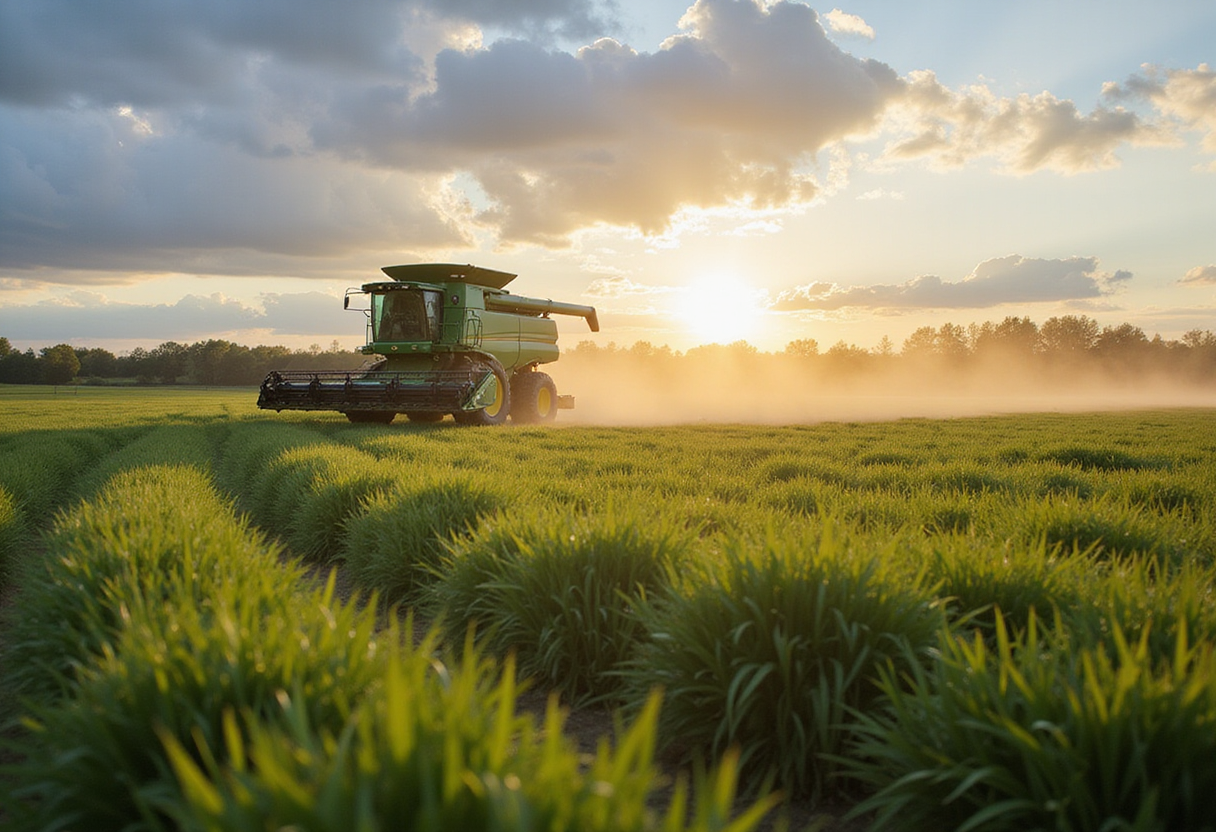
The global digital farming market was worth nearly $30 billion in 2025 and is projected to exceed $84 billion within eight years — yet a peer-reviewed study published in January in the Nature portfolio found that claims precision agriculture cuts fertilizer, pesticide, water use and greenhouse gas emissions are "not fully tested nor supported by evidence."
The finding cuts at the core premise of a technology sector that has reshaped American fieldwork since John Deere widely marketed the first GPS-guided tractor in the 1990s. Today's machinery functions as a million-dollar computer on wheels, linked to satellites, cloud storage, machine learning and AI, generating algorithmic recommendations on fertilizer rates, pesticide applications and seed placement.
The January study, which analyzed existing research on precision agriculture's environmental benefits, did find some evidence of reduced fertilizer use. Overall, however, the authors identified limited research and studies that overstated environmental gains. "This finding is significant," they wrote, "both for upholding rigor within the scientific community and for implementing more sustainable agricultural practices around the world."
The critique carries financial weight for growers. Fertilizer remains the dominant source of nitrous oxide from agricultural soils — a greenhouse gas with at least 265 times the atmospheric warming power of carbon dioxide, according to EPA. NOAA research shows nitrous oxide emissions rose 40 percent between 1980 and 2020. The HEAL (Health, Environment, Agriculture, Labor) Food Alliance noted in a report last year that pesticide and fertilizer use have both increased since precision agriculture took hold — a record that complicates the technology's climate pitch.
Taxpayer dollars at stake
Federal spending on precision agriculture is substantial and growing. A 2024 Government Accountability Office report found USDA and the National Science Foundation spent $200 million on related research and development between 2017 and 2021. USDA spent another $290 million between 2008 and 2018 on automation projects, some using precision tools.
The House Agriculture Committee's most recent Farm Bill draft, released this month, would go further: precision agriculture practices would qualify as conservation measures, with the government covering as much as 90 percent of farmers' costs through the Environmental Quality Incentives Program and the Conservation Reserve Program.
"There are many claims that precision agriculture, in a way, is like a silver bullet for sustainability," said Celize Christy, an organizer with the HEAL Food Alliance. "But it really is not that much different."
The Big Tech–Big Ag alliance
This week, the International Panel of Experts on Sustainable Food Systems (iPES Food) published its own critique, warning that a "powerful new alliance between Big Tech corporations" — naming Google, Microsoft, Amazon and Alibaba — "and Big Ag firms is rapidly gaining control of farming under the guise of innovation."
"These Big Tech titans are providing cloud platforms and AI-driven decision tools being integrated into all parts of industrial agriculture, from seeds to chemical inputs to machinery," the report states. "As a result, they are shaping what technologies are developed, how food production decisions are made, and what the future of farming looks like."
Lim Li Ching, one of the report's authors, acknowledged technological innovation could prove critical for feeding roughly 2 billion additional people by 2050. "The point of the report," she said, "is to ask: How are these technologies governed? Who do they benefit? Does this actually end up empowering farmers or does it shift the control and decision making on farms away from farmers into corporations?"
The authors argue the answer favors consolidation: data control — covering weather, soil conditions, topography, fertilizer application and seed types — is becoming a new source of power and profit in the roughly $10 trillion global food system. Proprietary algorithms and farm-data ownership, they contend, remove decision-making from farmers and push operations toward larger monoculture systems that require more fuel-based inputs while depleting soil carbon. Alibaba has already built its own platforms for managing crop and livestock data in real time.
Pat Mooney, another report author who has researched agricultural consolidation, said the tech companies see a straightforward market opportunity. "The information systems and data management, the data centers, all the sensors and satellites, all fit together, and they can happily monitor oceans and cropland," he said.
The report also flags the energy footprint of the digital infrastructure itself: by 2026, data centers' electricity consumption could rival Japan's total national usage.
Industry and laureates push back
The agriculture lobby has signed on, cautiously. "We embrace this new frontier through the lens of our policy," American Farm Bureau Federation President Zippy Duvall wrote in a 2024 blog post. "I'll call it a cautious approach. Farmers and ranchers see the potential of AI in enhancing productivity and sustainability on the farm, but we recognize the importance of ensuring that AI technologies are deployed ethically and responsibly."
In 2025, 154 Nobel and World Food Prize laureates issued an unprecedented plea for "planet-friendly 'moonshot' efforts leading to substantial, not just incremental, leaps in food production," citing AI, computational biology and advanced genomic techniques as necessary tools to avert a global food supply mismatch by mid-century.
The iPES Food and HEAL researchers do not oppose innovation itself. "People say, well, farmers can't really innovate, but that's not true," Ching said, pointing to agroecological practice and farmer seed systems. "What we want to do is refocus the narrative to what farmers are doing on the ground."
As the House Farm Bill draft moves through committee with its expanded 90 percent cost-share for precision practices, that debate over who controls farm data — and whether the environmental math holds — will likely shape both conservation spending and input decisions for years to come.
via about.deere.com (Original)
More from Grace Kim
Show full bio
Correspondent covering industry trends and analytics at Agribusiness Wire.
159 articles
Also in the yard
- Precision Ag Adds $118,000 Per 1,000 Acres, AEM Study Finds
- OSU Ph.D. Student Wins Global Fellowship to Push Precision Agriculture
- Purdue Study: Only Two Precision Ag Tools Pay Their Way
- Precision Agriculture: Drones, Satellites and AI Target Input Costs
- HEAL Report Brands Precision Agriculture a 'Distraction' From Food System Reform