Lot No. LOT-5028 · offered September 29, 2026
Precision Agriculture & AgTechLot sheet
NSF Grants $618,201 for Drone-Robot Teams in Precision Ag
A $618,201 NSF CAREER Award funds University of Nevada, Reno research pairing drones with ground robots to cut fertilizer and pesticide use in arid-climate cropping.
Market notes
- Assistant Professor Parikshit Maini received a five-year, $618,201 NSF CAREER Award for coordinated air-ground robot research in precision agriculture.
- The project targets fuel management, robot-to-robot communication and task uncertainty, plus coordinated sensing combining drone top-down views with ground-robot side views.
- Maini also works on RoboHydra, a sheep-monitoring robot, and is developing autonomous space worker robots with Associate Professor Christos Papachristos.
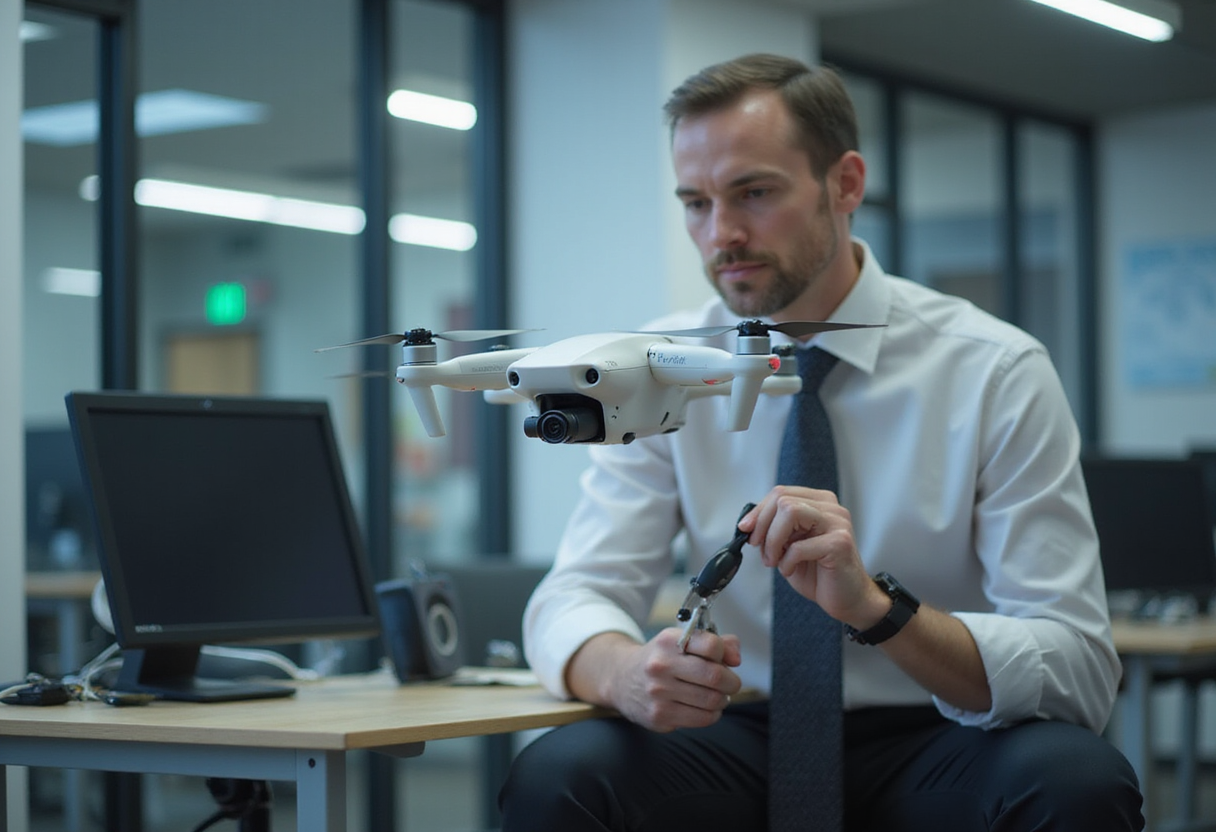
A five-year, $618,201 National Science Foundation CAREER Award will fund research at the University of Nevada, Reno into coordinated teams of drones and ground robots that could cut fertilizer and pesticide use for farmers operating in Nevada and other arid climates.
Assistant Professor Parikshit Maini secured the award this summer for the project, "From Fields to Decisions: Planning and Sensing Cooperative Teams of Air and Ground Robots in Precision Agriculture." The Faculty Early Career Development Program is the NSF's most prestigious award for early-career faculty. Maini earned his Ph.D. in computer science and engineering in 2020 from Indraprastha Institute of Information Technology Delhi and joined the University of Nevada, Reno in 2023.
For growers, the stakes center on input efficiency. The project aims to let aerial and ground robots jointly monitor crops and apply targeted treatments, reducing fertilizer and pesticide applications. It also could help agricultural scientists evaluate plant varieties more efficiently — a bottleneck in breeding programs that increasingly rely on field phenotyping.
Three coordination problems
Maini, a field roboticist who designs autonomous mobile robots, identifies three core challenges in pairing drones with ground machines.
The first is fuel. A single drone may lack the battery capacity to monitor a large field on one charge. One fix: have the drone land on the ground robot, which recharges its battery. But the handoff is difficult to schedule.
"Let's say the aerial robot is estimated to consume a certain amount of fuel, but it consumes more, or less," Maini said. "Based on that, (the robots) might need to meet earlier than they planned (or at a different location)."
The second is communication. "If communication (between the robots) breaks down, then what happens?" Maini asked. The third is task uncertainty — robots assigned to jobs like spot-spraying fertilizer face inherent unknowns in how long a task takes and how much fuel it burns.
The project also involves coordinated sensing, with each robot gathering and sharing information about plants from complementary angles. The drone supplies a top-down view; the ground robot supplies a side view. Combined, the perspectives build a full plant model that can be evaluated for health or other characteristics.
"So many robotics problems exist in this space," Maini said. "That's why this is very interesting to me."
Applications beyond the field
Maini's research is rooted in computer science, but much of his portfolio addresses agriculture directly. He works with faculty at the university's College of Agriculture, Biotechnology and Natural Resources on RoboHydra, a wheeled robot that travels with grazing sheep, providing water, tracking location and monitoring animal health. As a postdoctoral associate at the University of Minnesota, he worked on CowBot, a robotic rangeland mower built to remove weeds.
"Agriculture is a very important application, because it directly relates to what we eat," Maini said.
The cooperative-robotics capabilities he is building also extend beyond farming. He and Associate Professor Christos Papachristos are developing technologies for autonomous space worker robots that could build and prepare sites on the moon and Mars ahead of future human and robotic missions.
"There are foundational capabilities (in the technology) that we're building in this project," Maini said, citing defense and infrastructure inspection as other potential applications.
Training the next cohort
Maini is also using the award to build workforce pipelines. Soon after arriving in Reno, he entered graduate students in the American Society of Agricultural and Biological Engineers' 2024 Student Robotics Challenge.
"I thought it would be a good opportunity for them to learn what it takes to design algorithms and learn the whole process (of developing a robot)," he said.
Students Arif Ahmed, Nathaniel Rose, Ritvik Agarwal and Gaurav Srikar formed Team SARAL-Bot, with Maini as faculty advisor. The team earned a best written report citation for its paper, "SARAL-Bot: Autonomous Robot for Strawberry Plant Care."
Under the CAREER Award, Maini will continue outreach through 4-H youth programs, summer camps and school visits, and his grant proposal includes developing new curriculum at the intersection of robotics, AI and agriculture.
"As a land grant institution, I feel that it is very important that we give back to society," he said.
Over the five-year award period, the project's output will be algorithms and sensing architectures for air-ground robot teams — work that, if it matures, could give arid-climate growers a practical route to lower input bills and more precise field monitoring.
via unr.edu (Original)
More from Grace Kim
Show full bio
Correspondent covering industry trends and analytics at Agribusiness Wire.
159 articles
Also in the yard
- Robots, Drones, and Digital Tools: The Next Generation of Crop Protection
- University of Georgia Precision Ag Institute Funds Six New Seed Grants
- Universities Launch High-Tech Agriculture Degrees as Farming Goes Digital
- SIU Researchers Build Robot, AI to Detect Soybean Diseases Early
- Agriculture Ministry to offer free AI, drone and robotics courses this autumn