Lot No. LOT-2096 · offered September 29, 2026
Precision Agriculture & AgTechLot sheet
SIU Researchers Build Robot, AI to Detect Soybean Diseases Early
SIU's Samuel Singh and Billy Ram built a camera-equipped robot to gather soybean field data, aiming to predict diseases before symptoms appear on leaves and stems.
Market notes
- Southern Illinois University researchers built a multi-camera field robot to detect soybean diseases before visible symptoms appear.
- Doctoral student Samuel Singh leads the machine's development under Billy Ram, assistant professor of precision agriculture.
- The project is in its data-collection phase; the team aims to gather enough imagery to train AI models for early disease prediction.
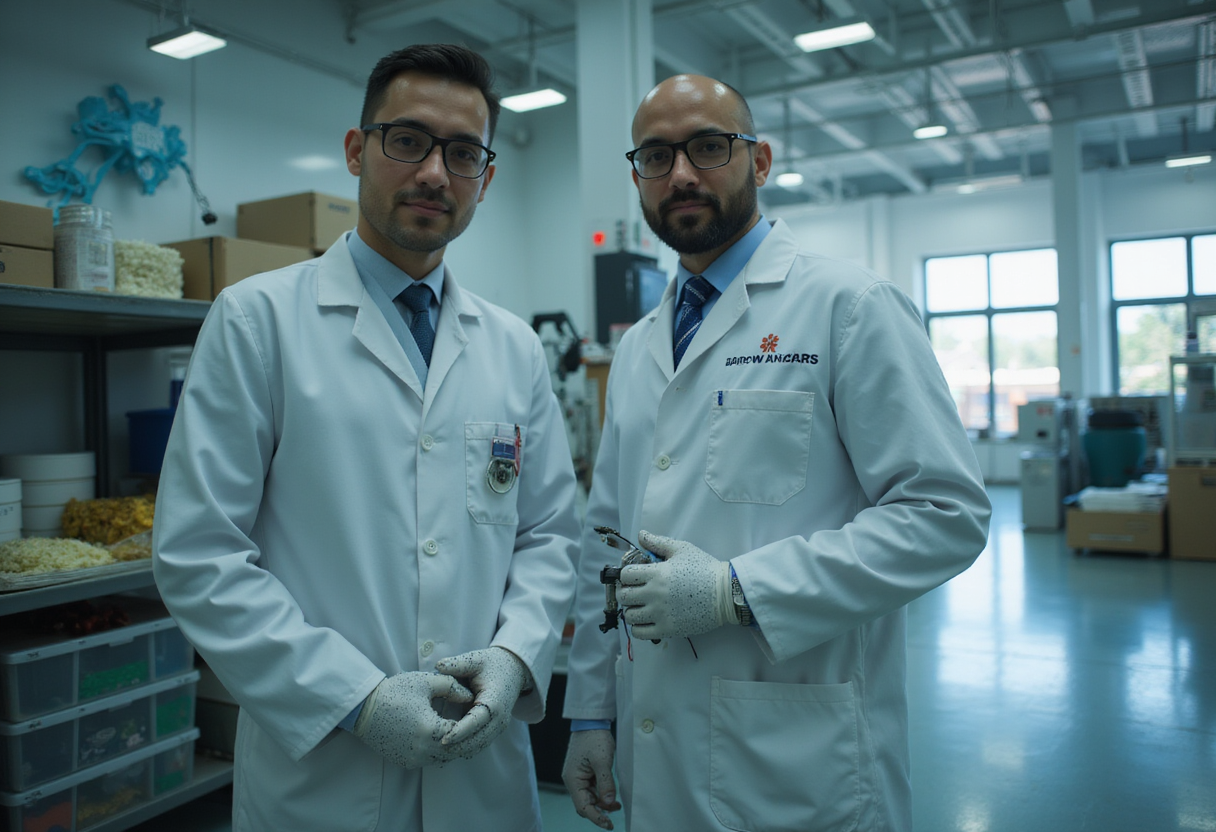
Researchers at Southern Illinois University have built a field-ready robot designed to detect soybean diseases before symptoms appear on leaves and stems — a development that, if validated at scale, could give growers a head start on pathogens that quietly erode yields.
Samuel Singh, a doctoral student in SIU's agricultural sciences program, showcased the machine, which carries multiple cameras that capture images of soybean crops in the field. Billy Ram, assistant professor of precision agriculture, guides the project. The team's stated goal is to collect enough field data to train artificial intelligence models capable of predicting disease outbreaks before visible damage sets in.
That early-warning window matters for farm margins. Fungal and bacterial soybean diseases — including those that show foliar symptoms only after infection is established — often force growers into curative fungicide applications with uncertain payback, or into yield losses that go unexplained until harvest. A detection system that flags infection during the latent period could shift treatment decisions from reactive to preventive, cutting input costs on unaffected acres and protecting yield on those at risk.
The project is still in the data-collection phase. Singh and Ram's robot gathers imagery across soybean fields, and the research team aims to accumulate a dataset large enough for AI models to recognize disease signatures — subtle patterns in plant appearance that precede symptom development. No prediction accuracy rates, deployment timelines, or commercialization plans appear in the project's public description, so growers should treat this as research-stage work rather than a near-term scouting replacement.
For agronomists and crop consultants, the technology points toward a practical shift in how scouting is done. Multi-camera field robots can cover more acres per day than manual scouts and capture consistent imagery that human observers cannot standardize across fields and seasons. If the underlying models hold up, the same data streams could eventually feed into variable-rate fungicide prescriptions, tying disease pressure maps directly to input spending.
The project also reflects a broader trend at land-grant universities: pairing precision-agriculture hardware with machine learning to address disease pressure that costs U.S. soybean growers hundreds of millions of dollars annually in lost yield and treatment expense. SIU's program, situated in a major soybean-producing state, positions its researchers to test the system against the disease spectrum prevalent in Midwest fields.
Key questions remain before the robot moves beyond campus trials. The researchers have not yet published results on how early their models can flag infection relative to symptom onset, how the system performs across cultivars and growth stages, or how it handles field variability in light, residue, and canopy density — the conditions that routinely degrade machine-vision performance in commercial settings.
Singh and Ram's next steps center on expanding the dataset. The more imagery the robot collects across infected and healthy fields, the better the odds that the AI can distinguish pre-symptomatic disease stress from ordinary crop variability. If those models prove reliable in replicated field trials, the tool could move toward grower-facing deployment — giving soybean producers a way to act on disease threats before those threats become visible, and costly, in the canopy.
via news.siu.edu (Original)
More from Nathan Brooks
Show full bio
Staff writer covering marketplaces and e-commerce at Agribusiness Wire.
173 articles
Also in the yard
- Missouri Soybean Growers Bet on Robotics and Precision Ag
- Robots, Drones, and Digital Tools: The Next Generation of Crop Protection
- AI Offers Promise for Agriculture, but Smallholders Risk Being Left Behind
- Orchard Robotics Pitches 3-10x ROI on Per-Acre Scanning Subscriptions
- New U.S. Bill Aims to Push AI Onto Farms Most Growers Still Ignore