Lot No. LOT-9858 · offered November 6, 2026
Precision Agriculture & AgTechLot sheet
GigaCrop Claims AI Could Double Corn Yields by Fixing Photosynthesis
GigaCrop has raised $7.2 million to build AI-designed enzymes that bypass Rubisco, claiming a path to double corn yields. First plant data is due within a year; no field trials yet.
Market notes
- GigaCrop has raised over $7 million: $2.7M in grants (Grantham Foundation, DOE ARPA-E) and $4.5M from Playground Global.
- Founder Chris Eiben projects the technology could double corn yields; initial data from first engineered plants is expected within a year.
- Rubisco runs about 10 times slower than typical plant enzymes, and its error-repair cycle can cut photosynthesis efficiency by up to 50%.
- Plants waste roughly 9 of every 10 photons received, according to Eiben; Rubisco makes up 30–50% of the world's proteins.
- No field trials have started; commercialization would come as a seed trait in corn and soybeans, possibly sugarbeets.
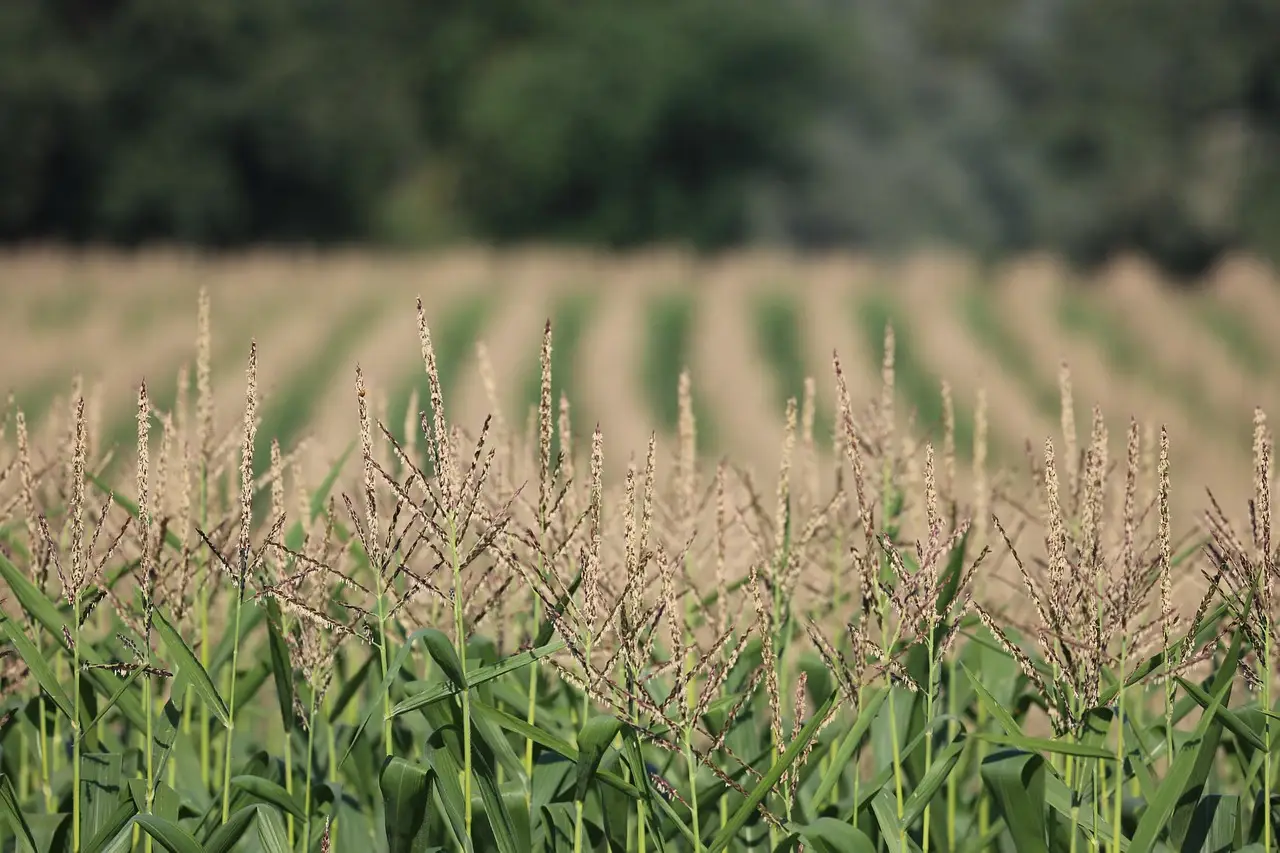
A startup with $7 million in funding says it can double corn yields by re-engineering photosynthesis — a claim built so far on lab-stage biology, with the first plant data still up to a year away.
GigaCrop, working out of EnterpriseWorks, the startup incubator at the University of Illinois Research Park, has raised $7.2 million across grants and venture capital to develop AI-designed enzymes that work around photosynthesis's central bottleneck. The money breaks down into $2.7 million in grants from the Grantham Foundation for the Protection of the Environment and the U.S. Department of Energy's ARPA-E, plus $4.5 million from Playground Global, a California technology venture firm.
Founder Chris Eiben believes the product could double corn yields. That is a projection, not a result. No field trials have started, and the first corn plants carrying the trait are still being developed.
What's wrong with Rubisco?
The target is Rubisco, the enzyme that drives carbon fixation in every green plant. Shawn Carlson, head of plant transformation at GigaCrop, said Rubisco runs about 10 times slower than a typical enzyme in a plant's core metabolism.
Plants compensate by producing huge amounts of it, tying up resources. The enzyme also makes mistakes, triggering a repair process that Eiben said can cut photosynthesis efficiency by as much as 50%.
"Because of this bottleneck, plants typically waste about 9 of every 10 photons they receive," Eiben said. Even so, Rubisco accounts for 30% to 50% of the proteins in the world.
The takeaway: an enormous share of the sunlight a cornfield captures never becomes grain, and that gap is the company's entire business case.
How the technology works
GigaCrop uses artificial intelligence to identify and evaluate enzyme combinations for an alternative carbon-fixation pathway that runs alongside Rubisco rather than modifying it.
"As our enzyme engineers find enzymes that work, we're putting them into plants and then testing them to see if it is making a difference," Carlson said. The team starts with corn, using a gene gun to introduce DNA into plant cells. Once that DNA incorporates into the genome, researchers grow whole plants and measure how the trait performs.
Carlson called AI a genuine shift for a field where scientists have chased photosynthetic efficiency for years. "AI is helping us find promising enzymes that we might not have otherwise considered," she said.
The distinction matters competitively: other companies are trying to modify Rubisco itself, while GigaCrop's pathway runs parallel to it. A more efficient carbon-fixation route, the company argues, would let farmers produce more grain with the same or fewer inputs.
"You could use less land, and you could get so much more yield just because the plant's able to use more sunlight and be more efficient," Carlson said.
What happens next
The commercial path, if the biology holds, runs through familiar channels. GigaCrop expects to deliver the technology as a trait in seeds farmers already buy, focused first on corn and soybeans, with possible expansion into sugarbeets. The company has not finalized its go-to-market method — it could license the trait to seed companies or sell seed directly.
Carlson framed the race broadly: "If anybody can improve photosynthesis, it's a win for agriculture and humankind."
For now, growers should treat the doubled-yield talk as a hypothesis with funding behind it, not a product with data. Initial results from the first engineered corn plants are expected within the next year, and those numbers — not the projections — will show whether the claim holds.
via Farm Progress (Source)
More from Olivia Hart
Show full bio
News editor covering technology and product news in Agribusiness coverage for industry professionals at Agribusiness Wire.
476 articles
Also in the yard
- IMIO banks $12m seed to turn corn stover into fertilizer savings
- Lilac Agriculture raises $2.3m to fix inoculants' 'black box' problem
- Capital Flows and Carbon Credits: AgTech's Week in Numbers
- Wisconsin Agtech Startup Raises $5M to Develop AI-Designed Herbicides
- Lilac Agriculture Raises $2.3M to Open the 'Black Box' of Inoculants