Lot No. LOT-1939 · offered September 29, 2026
Crop EconomicsLot sheet
Drought Devastates Soybean Yields Across Central Kansas
Central Kansas farmer Paul Penner reports empty pods and brown spots after nearly three months without measurable rain, as growers begin salvaging a drought-stricken soybean crop.
Market notes
- Central Kansas received no measurable moisture for nearly three months during the soybean growing season.
- Farmer Paul Penner reports pods formed but contain no beans; fields show brown spots on conventional soybeans.
- Some growers in the region have already begun harvesting or acting on the drought-damaged crop.
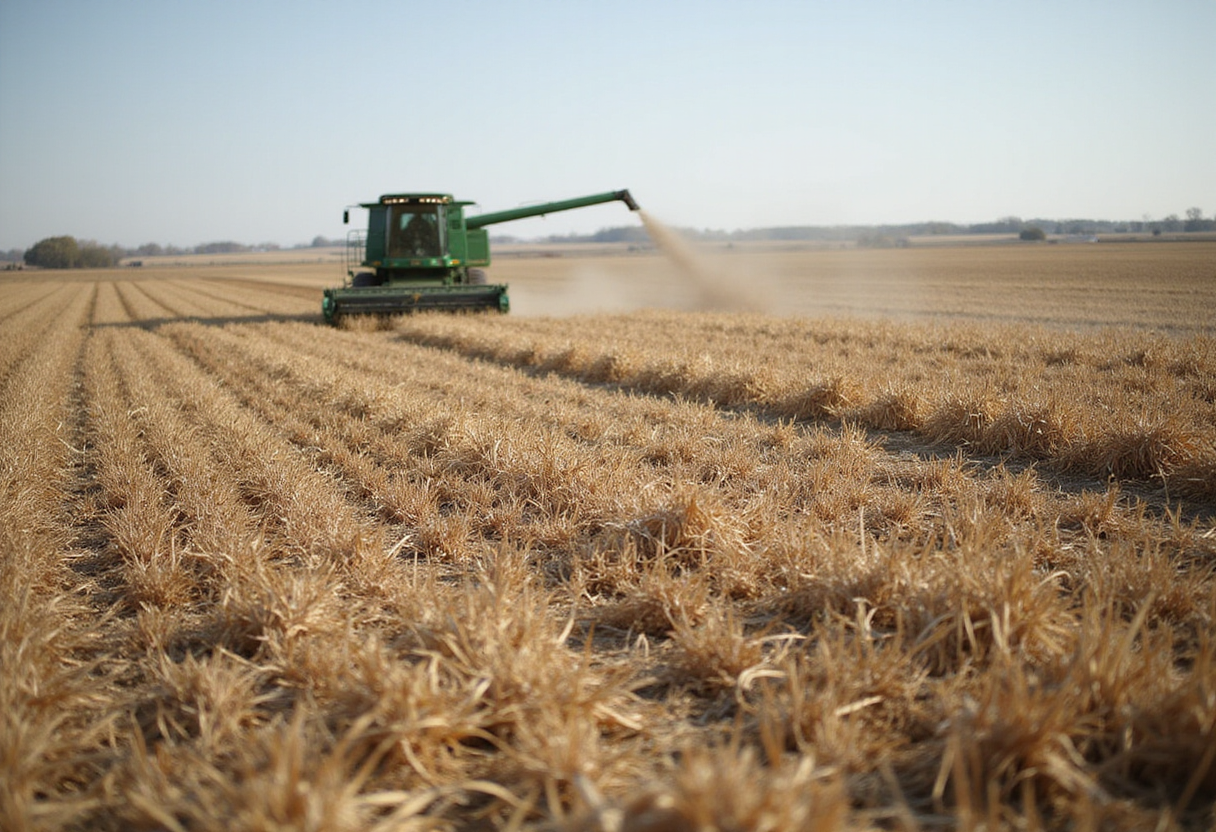
Central Kansas soybean growers are harvesting a crop that, in many fields, barely exists. Paul Penner, who farms in the heart of the drought-affected region, describes stands in terms that leave little room for interpretation: "There are just literally brown spots on the regular beans. There are pods there, but there is nothing in them."
Pods without beans mean the season's yield potential collapsed well before combines rolled. Penner's account points to the mechanism behind the loss: the region went nearly three months without measurable moisture. For a soybean crop, that timing is close to a worst-case scenario. The plants set pods during the dry stretch, but without soil water to fill them, the grain inside never developed.
The damage Penner reports is visible from the cab. Brown patches punctuate the conventional-bean fields, marking ground where plants ran out of water entirely. Where pods did form, they hang empty. That distinction matters for anyone estimating regional production: an field with pods is not necessarily a field with a crop.
Penner shared his assessment with Brownfield, and his report tracks with the broader condition of the central Kansas soybean belt this season. An extended stretch without measurable precipitation does not merely trim yields at the margin. It removes them. When the rain gauge sits empty for roughly a quarter-year spanning the critical reproductive window, pod fill fails, and harvest math follows the biology.
"Some guys have already" begun acting on that reality, Penner noted — his comment cut off in the original report, but the implication for harvest progress is clear: some producers in the region have moved early, salvaging what the drought left rather than waiting on fields that will not improve.
For growers like Penner, the arithmetic is unforgiving. Input costs — seed, fertilizer, fuel, crop protection — went into the ground at full rates. The revenue side of the ledger now depends on how many bushels those empty pods can still yield, and on whatever crop insurance guarantees apply to the affected acreage. Revenue protection tied to a county or individual yield history will cushion some of the loss, but it will not turn brown spots into saleable beans.
The central Kansas report also carries weight beyond the affected counties. Every bushel the region fails to produce tightens the state's contribution to national soybean supply, and Kansas sits inside the western fringe of the belt where dryland production dominates and irrigation options are limited or absent. Condition reports like Penner's are exactly the kind of ground-truth that survey-based yield estimates must reconcile against as USDA refines its production numbers through the fall.
The distinction between condition and harvested results remains important here. Penner's account is a field-level observation of a crop still being taken out — a condition report, not a final yield tally. Harvested results from the region will follow as combines finish, and they will quantify what the empty pods already suggest.
What happens next depends on weather the region cannot control: moisture arriving in time to protect the remaining fields still standing, and whether late-season rains offer any rescue for acres not yet harvested. For now, growers like Paul Penner are working through a crop the drought largely decided months ago.
via Brownfield Ag News (Source)
More from Rebecca Stone
Show full bio
Market editor covering industry trends and analytics at Agribusiness Wire.
134 articles