Lot No. LOT-9333 · offered October 2, 2026
Precision Agriculture & AgTechLot sheet
K-State Garden City Researchers Recalibrate Cotton Water Use for High Plains
K-State's Garden City station spends nearly $100,000 on soil moisture sensors across 100 plots as FFAR-backed corn-cotton rotation research recalibrates cotton water use for High Plains irrigators.
Market notes
- SWREC Garden City has grown irrigated cotton for roughly six or seven years, starting after its research advisory committee raised the topic in about 2017.
- Kansas crop coefficients for irrigated cotton differ from Texas and California literature, and researchers are refining them for local irrigation scheduling.
- Soil moisture sensors across roughly 100 plots at the Finnup field cost nearly $100,000; soil carbon will be remeasured in years three and five of the FFAR project.
Researchers at Kansas State University's Southwest Research and Extension Center in Garden City are spending up to $100,000 on soil moisture sensors alone in a single research field — roughly 100 plots — as they quantify water use, soil carbon and nitrogen dynamics under corn-cotton rotations in the Ogallala-tapped High Plains.
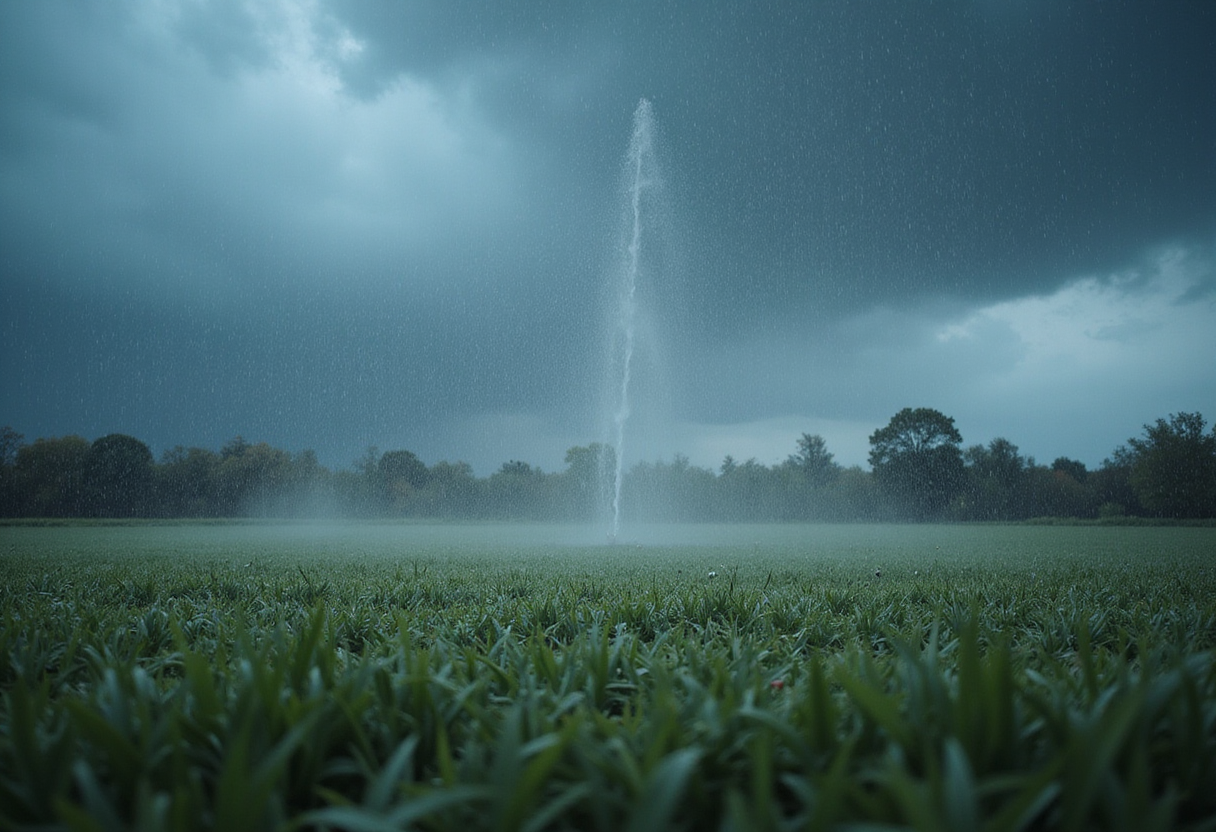
The work took center stage at SWREC's annual Fall Field Day in late August, where late-season rain showers cooled what is typically a hot walking tour. Brian Olson, professor and head of the Western Kansas Research Extension Centers, said Kansas State recently opened its Agronomy Innovation Center on campus, with more facilities opening in the coming weeks.
"That's going to be a great asset as we look at moving crop production research forward, especially with those undergraduate education experiences," Olson said. He emphasized that partnerships with industry and with farmers who use the research centers shape the station's agenda.
Jonathan Aguilar, professor at SWREC in Garden City, said his team has been preparing for the field day since March. At the start of the tour he challenged attendees directly: "Ask questions. Is there anything that we are not trying? Are we not addressing the needs of, particularly for the farmers here in this region? That's the reason why we are here is to actually try to do the research of the things that is needed in this region."
One tour stop was the Finnup field, where Aguilar discussed water dynamics in a corn-cotton rotation. Graduate students presented projects including real-time drone streaming for precision agriculture. The irrigated acreage there also hosts a project tied to the Foundation for Food and Agriculture Research.
The cotton work began roughly six or seven years ago, after the station's research advisory committee asked in about 2017 whether researchers were doing anything on irrigated cotton.
"We have been trying the irrigated cotton partly because one of the issues that we found for the cotton is that it is using less water in general," Aguilar said. His team reached out to colleagues in Texas to learn what irrigated cotton production required.
The current focus is refining crop coefficients — the relationship between crop growth stage and water consumption — because Kansas results diverge from the published literature.
"It is different from what we are seeing with the literature that was developed in Texas and in California, so we are trying to hone those numbers and try to make sure that those numbers are applicable to those folks that are using it now with the irrigation schedule," he said. For irrigators scheduling water applications against declining aquifer levels, coefficient accuracy translates directly into pumping costs and water saved.
The FFAR project — increasing water productivity through soil carbon and sustainability of multi-crop systems using field-scale research — takes a systems approach. "Not just the water. We are looking at the soil. We are looking at the rotation. We are looking at the nitrogen application and see what is going on," Aguilar said.
Partner sites in Iowa, Minnesota, Illinois, Ohio and Nebraska concentrate on corn and soybeans. Aguilar pushed to include cotton in Garden City, partly because the region lacks soybean acreage, and swapped the Midwest cover crop suites for rye, a species more accessible to local farmers. Researchers tried wheat as a cover the first year; the rye grown in the second year performed better.
The plot design includes continuous corn, continuous cotton and a corn-cotton rotation, with nitrogen applied both pre-plant and through an irrigation system capable of fertigation. The system can apply nitrogen in one spot, shut it off as it moves, and shift to another area. Conventional-field plots split into tilled, no-till and strip-tilled treatments.
Sensor placement across the 100-plot field is deliberate. "Soil moisture sensors are not cheap," Aguilar said. "If you're looking with a plot with multiple replications, it gets to about almost $100,000 just to put sensors just in this field." Additional measurements track greenhouse gas emissions. Water-level monitoring was ruled out for parts of the project because the water table sits about 150 feet below ground at that location.
Weed seed bank analysis showed a correlation between rotation, the seed bank and cover crop biomass. Soil organic carbon sampling is underway, with baseline measurements taken and repeat sampling planned in years three and five to test for treatment differences.
In the cotton fields, Aguilar's team observed that drought-resistant varieties withstand heat and dry stretches better than corn, thanks to a complex root system. "They are not only getting their moisture right on the top, but they also have the tap root so that it's if it doesn't rain and we don't get the timely rainfall, they are actually going to mine the water from the tap root," he said. "And they are able to survive at least a little bit longer than what a typical corn or other crop would be."
With year-three and year-five soil carbon measurements still ahead, the Garden City trials are positioned to give High Plains growers locally calibrated cotton coefficients and rotation data within the next several seasons.
via High Plains Journal (Source)
More from Nathan Brooks
Show full bio
Staff writer covering marketplaces and e-commerce at Agribusiness Wire.
182 articles
Also in the yard
- University of Wyoming Sets Field Day on New Research, Precision Ag
- OSU Ph.D. Student Wins Global Fellowship to Push Precision Agriculture
- Iowa State Agronomist: Persistent Rain Stalls Harvest, Quality Erodes
- Missouri Soybean Growers Bet on Robotics and Precision Ag
- USDA Facility Closure in Maryland Channels $37 Million to UNL Ag Research